Case Study · 2026
Sous
A recipe platform with an AI sous-chef that plans your week around your tastes, allergies and nutrition targets — then hands you the shopping list. Built as a Turborepo monorepo with a typed ElysiaJS API, subscription billing and an MCP server, shipped on Vercel.
Background
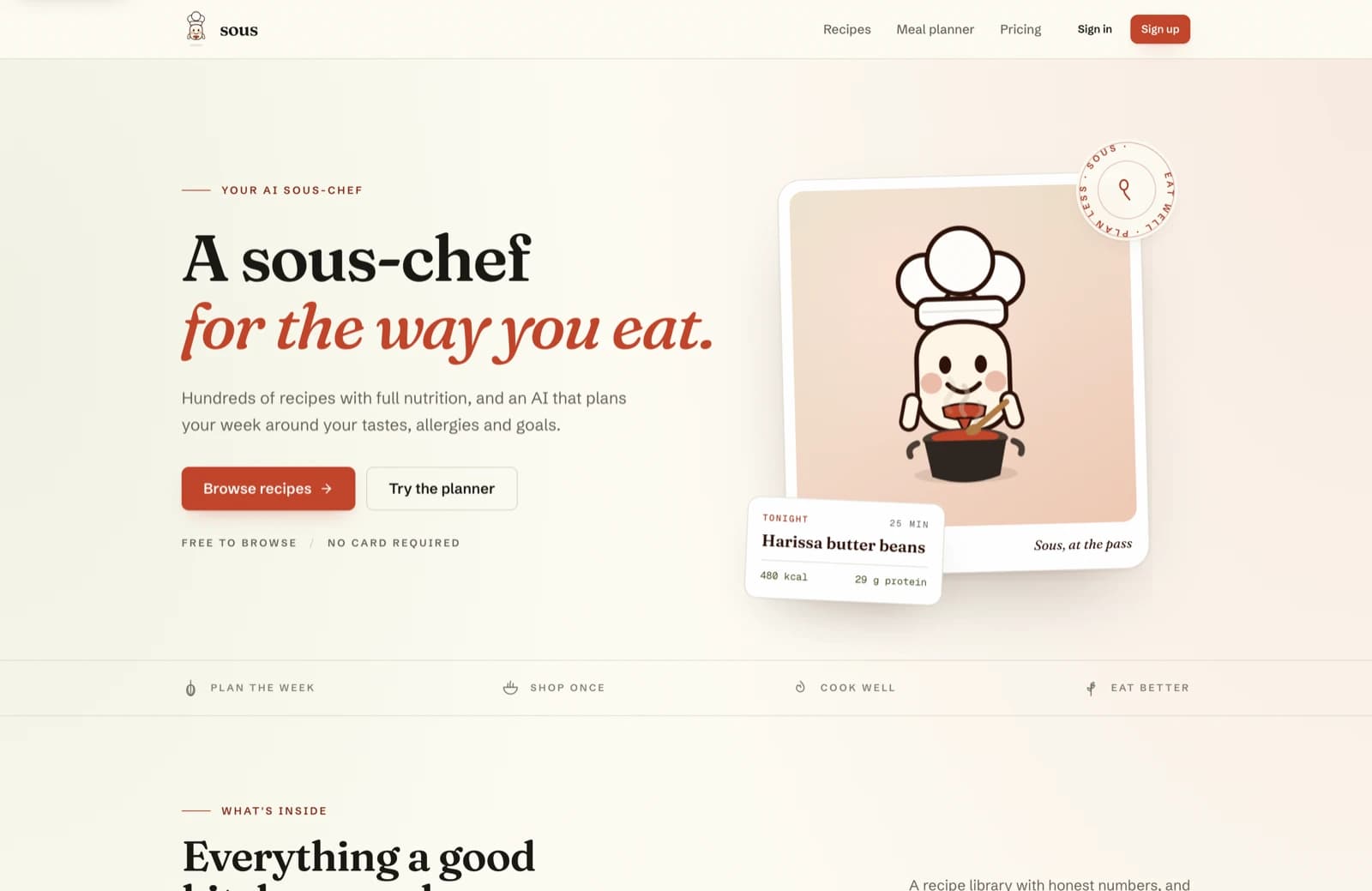
Sous is a recipe site with an AI meal-planner at its centre. You browse recipes with full nutrition, save the ones you like and author your own; then you describe the week you want — “high-protein, mostly vegetarian, quick dinners” — and an agent builds a balanced seven-day plan around your preferences and allergies, aggregates every ingredient into a shopping list, and unlocks a curated premium recipe library for subscribers. It is a full subscription product rather than a toy: accounts, three paid tiers, metered usage, and the observability to run it in production.
A Turborepo monorepo on Vercel
The codebase is a Bun-powered Turborepo. A Next.js 16 App Router front end and an ElysiaJS API deploy as two separate Vercel projects from one repo, over a set of shared packages — database, auth, AI, email, analytics and a contracts package that every layer imports. Splitting the API out from the site keeps the stateful, long-running work behind its own origin while the public, cacheable front end gets image optimisation and the edge CDN. Data lives in Neon Postgres, accessed through Drizzle with code-first migrations.
End-to-end type safety
The keystone is a single contracts package of Zod schemas, shared by the API for runtime validation, the web app for its forms and the AI agent for its tool I/O. On top of that the web talks to the API through Eden Treaty — a client inferred from the API’s exported type — so every request and response is typed end to end with no codegen step. One source of truth for shapes, checked everywhere: a change to an API route surfaces as a type error in the web app before it ships.
Accounts and subscriptions
Authentication is BetterAuth, mounted inside the Elysia API and shared with the web app through a cross-subdomain session cookie, with social sign-in. Billing is Stripe through BetterAuth’s Stripe plugin: three paid tiers, each registered by its Stripe Price ID, with Checkout and the customer billing portal. A user’s tier is derived from their live subscription and drives what they can do — how many recipes they can author, how many AI plans they get a month, and whether the premium library is unlocked.
The AI sous-chef
The planner is an agent built with the Vercel AI SDK, running inside the API against an OpenAI-compatible model that is swappable by environment. It is a tool-calling loop: the agent searches recipes, reads the user’s preferences, checks a recipe’s ingredients and nutrition, and finally writes a structured plan — every tool scoped server-side to the signed-in user, so the model can never widen its own privileges. The system prompt anchors the week to globally recognised daily nutrition guidance while always deferring to the user’s own targets and allergies.
The shopping list is deliberately not left to the model: once a plan is saved, the API aggregates the real ingredients across every recipe, scaled by servings and de-duplicated, so the quantities are correct rather than merely plausible. Generations are metered as credits per tier and rate-limited — the free plan gets one a month.
Security, observability and MCP
Because the planner takes free-text input and calls tools, it is built against the OWASP Top 10 for LLM Applications: user text is treated as data, validated and length-capped; tool privileges are bound to the session, never the prompt; model output is schema-validated before any write; and generation is bounded by token, step and rate limits. Every AI call, tool span and business event flows to PostHog over OpenTelemetry, so token cost and latency are visible in production, and transactional email runs on Resend with React Email.
The same recipe data is exposed through a Model Context Protocol server, so an external AI client can search and read recipes with the exact tools the in-app agent uses — the product is usable by an agent, not just a browser.